
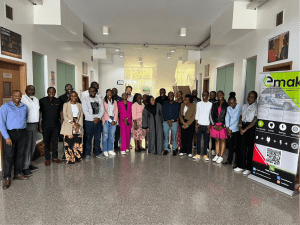
 The Electric Mobility Association of Kenya (EMAK) convened its members for an Industry Round Table on 27 March 2026 at Strathmore University, Nairobi. The session brought together players across the electric vehicle ecosystem, including manufacturers, financiers, charging infrastructure providers, academic institutions, and policy stakeholders, with a shared goal of aligning on priority actions needed to accelerate EV adoption in Kenya.
The round table focused on consolidating member priorities into a unified industry agenda, identifying practical action steps, and mobilizing coordinated implementation for a faster, more inclusive, and more sustainable electric mobility transition in Kenya.
Participants reached strong alignment on six core areas that must be addressed to unlock Kenya’s electric mobility potential.
Members emphasized that all existing EV incentives must be retained without exception, noting that removing even one incentive could disrupt the entire EV value chain. There was also strong support for broadening incentive coverage to include trucks, three-wheelers (tuktuks), and passenger cars.
Participants also proposed the development of appropriate Harmonized System (HS) codes for motorcycles, electric bicycles, trucks, and other EV categories, with distinctions between assembled and unassembled units where necessary.
To give investors and industry players greater certainty, members supported the creation of a long-term incentive plan tied to investment roadmaps. The Ministry of Energy, working with the Ministries of Trade and Transport, was identified as a key lead in delivering a substantive e-mobility impact report.
Members called for counties to be more actively engaged in creating seamless permitting processes and enabling charging infrastructure development, supported by a strong national awareness campaign.
Inclusion was another major theme. Participants highlighted the importance of designing EV products and services that are accessible to women, youth, and persons with disabilities (PWDs).
There was also a proposal to establish an EMAK accountability taskforce to monitor policy delivery, engage key ministries, and maintain a consistent public and media voice on e-mobility issues.
Round table participants agreed that tax incentives should play a direct role in reducing the cost of EV acquisition, while charging infrastructure should be embedded into building codes and new road projects.
There was strong recognition that financial institutions need a better understanding of electric mobility. Members noted that EV education and green financing policies are essential to unlocking affordable credit for consumers and businesses.
Participants also argued that EVs should be allowed to grow to critical mass before levies are introduced, with the view that electricity revenue generated through increased EV uptake could offset short-term fiscal gaps.
EMAK was encouraged to demonstrate the broader economic trade-offs and opportunities to government, including reduced fuel import bills, carbon credit opportunities, and local job creation.
The round table produced strong consensus around several immediate action areas:
While broad agreement was reached on many issues, members identified a few areas that still require further discussion and policy engagement:
The round table agreed on a phased implementation framework to translate industry priorities into measurable outcomes.
Expected outputs: Incentives retained in the Finance Bill, active taskforces, and reduced registration delays.
Expected outputs: A national EV roadmap, county engagement program, and new financing products.
Expected outputs: Installed charging stations, standardized licensing, and fleet electrification pilots.
Expected outputs: Local manufacturing capacity, battery lifecycle systems, and a stable policy framework.
The round table identified several actions that can begin immediately:
The round table concluded with a clear mandate: EMAK must serve as the unified, credible voice of Kenya’s electric mobility industry. This includes safeguarding the interests of all members through transparent, fair, and evidence-based engagement with government and other stakeholders, while ensuring that Kenya’s EV transition remains fast, inclusive, and sustainable.
As Kenya’s e-mobility ecosystem continues to grow, the outcomes of this round table provide a practical foundation for policy advocacy, industry coordination, and long-term sector development.
Prepared by Elijah Oduor, EMAK Executive Officer.